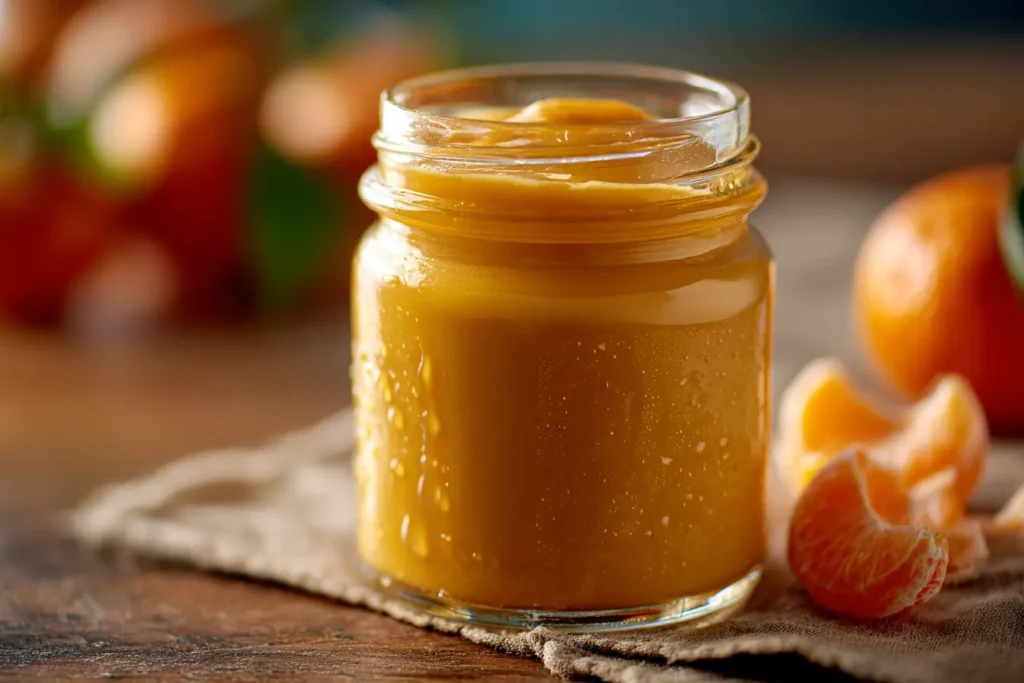
I have a weakness for citrus season. Every winter I swear I’m “just buying clementines for snacking,” and every winter I end up standing in my kitchen with sticky fingers, a zester in one hand, and absolutely zero self-control. The smell alone makes me happy. This clementine curd was born on one of those afternoons—music on, butter melting, me tasting straight from the spoon and pretending it’s “quality control.” It’s bright, silky, a little luxurious, and honestly one of my favorite things to make when my kitchen feels like my safe place.
Table of Contents
Table of Contents
What Is Clementine Curd (And Why It’s So Special)
Clementine curd is a bright, buttery citrus spread made by gently cooking clementine juice and zest with sugar, eggs, and butter until it turns thick, glossy, and spoonable. Think of it as lemon curd’s sweeter, softer cousin—still fresh and citrusy, but rounder, gentler, and a little more dessert-forward.
If you’ve made fruit curds before (like my Blackberry Curd), the technique will feel familiar—just with a sunnier, winter-citrus twist.
Clementine vs Mandarin vs Satsuma vs Tangerine
All of these belong to the mandarin family, which means yes, you can swap them in this recipe. What changes is the sweetness and acidity.
| Citrus Type | Flavor Profile | How It Affects the Curd |
|---|---|---|
| Clementine | Sweet, fragrant | Balanced, classic curd |
| Mandarin | Slightly floral | Deeper citrus flavor |
| Satsuma | Very sweet, low acid | Add a splash of lemon |
| Tangerine | Brighter, tangier | Sharper citrus edge |
Quick tip: always taste your fruit first. The curd can only be as sweet or tart as the citrus you start with.
Flavor Profile: Sweeter Than Lemon Curd
Because clementines are naturally less acidic than lemons, the curd comes out:
- Softer and rounder
- Bright but not sharp
- Naturally sweet without needing extra sugar
This makes it especially lovely for desserts where lemon curd can feel a bit too bold.
Best Ways to Use Clementine Curd (Quick Preview)
This is one of those recipes that quietly upgrades everything. A few favorite uses:
- Spread on warm scones (especially with my Master Scones Recipe)
- Swirled into yogurt or oatmeal
- Spooned over toast or English muffins
- Used as a filling for cakes, tarts, or thumbprint cookies
- Dolloped on pavlova for a bright, creamy contrast
(There’s a full “Ways to Use” section later—this is just a teaser.)
Classic vs Vegan Clementine Curd (What to Expect)
Both versions work beautifully, but the texture is different:
- Classic clementine curd:
- Silky, glossy, custard-like
- Best for spreading, layering, and spooning
- Vegan clementine curd:
- Slightly firmer, pudding-style texture
- Sets more in the fridge
- Great for jars, tarts, and dairy-free desserts
Choose based on how you plan to use it, not just dietary needs.
Print
Clementine Curd
- Total Time: 20–22 minutes
- Yield: About 1½ cups 1x
- Diet: Vegetarian
Description
This Clementine Curd is smooth, glossy, and perfectly balanced between sweet and tangy. Made with fresh clementine juice and zest, it’s softer and gentler than lemon curd, yet still bright and luxurious. Perfect for spreading, filling, swirling, or spooning straight from the jar.
Ingredients
-
4 medium clementines, zested and juiced (about ½ cup juice)
-
¾ cup granulated sugar
-
2 large whole eggs (or 4 egg yolks for a richer curd)
-
6 tbsp unsalted butter, cut into cubes
-
¼ tsp salt
Instructions
-
Prep the citrus
Zest the clementines first, then juice them. Set aside. -
Combine ingredients
In a medium saucepan, whisk together the clementine juice, zest, sugar, eggs (or yolks), butter, and salt. -
Cook gently
Place the pan over low to medium-low heat. Whisk constantly until the butter melts and the mixture thickens. Do not let it boil. -
Check doneness
The curd is ready when it coats the back of a spoon and a finger drawn through it leaves a clear line. -
Strain (optional but recommended)
Pour the curd through a fine-mesh strainer into a bowl or jar for an extra-smooth texture. -
Cool and chill
Let cool slightly, then refrigerate until fully set.
Notes
-
The curd will thicken more as it cools, so remove it from heat while it still looks slightly loose.
-
For a brighter flavor, add 1–2 teaspoons of lemon juice off the heat.
-
For a thicker, bakery-style curd, use egg yolks instead of whole eggs.
- Prep Time: 10 minutes
- Cook Time: 10–12 minutes
- Category: Breakfast
- Method: Stovetop
- Cuisine: European
Nutrition
- Serving Size: 1 tbsp
- Calories: 75 kcal
- Sugar: 7 g
- Sodium: 30 mg
- Fat: 5 g
- Saturated Fat: 3 g
- Unsaturated Fat: 2 g
- Trans Fat: 0 g
- Carbohydrates: 8 g
- Fiber: 0.2 g
- Protein: 1 g
- Cholesterol: 45 mg
Ingredients & Tools You’ll Need
Clementine curd uses simple ingredients, but each one has a purpose. Once you know why they’re there, the recipe feels easy and relaxed instead of intimidating.
Ingredients for Classic Clementine Curd
You’ll only need a few basics:
- Clementines – both the juice and the zest
- Granulated sugar – balances the citrus
- Eggs or egg yolks – help the curd thicken
- Unsalted butter – adds silkiness and shine
- Pinch of salt – brings everything into balance
Whole Eggs vs Egg Yolks (Quick Guide)
| Choice | Result |
|---|---|
| Whole eggs | Lighter, softer curd |
| Egg yolks only | Thicker, richer curd |
Whole eggs are great for spreading and everyday use.
Yolks give a more luxurious, bakery-style texture.
Zest Rules (So It’s Never Bitter)
- Zest only the bright orange peel
- Avoid the white pith underneath
- Always zest before juicing
A little care here keeps the curd fragrant and smooth.
Helpful Tools (Nothing Fancy)
- Saucepan
- Whisk
- Fine-mesh strainer (optional, for extra-smooth curd)
No special equipment, no stress — just gentle heat and patience.
Foolproof Clementine Curd Method (Step-by-Step)
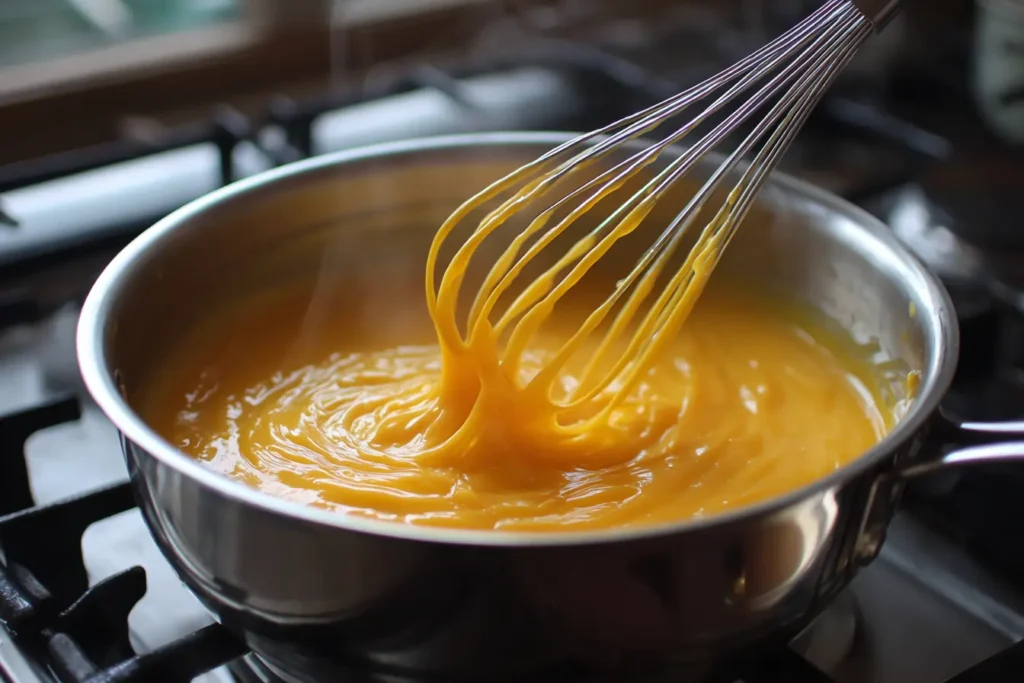
This method is all about gentle heat and patience. Clementine curd doesn’t need rushing—it needs attention. Follow these steps and you’ll get a smooth, glossy curd every time.
Step 1: Prep the Clementines
Before anything goes on the stove, prep your citrus.
- Zest the clementines first (only the bright orange peel)
- Juice them until you have the needed amount
- If your juice is very pulpy, you can strain it—but this is optional
Set everything nearby. Once you start cooking, you don’t want to step away.
Step 2: Cook Low and Slow
Add the juice, zest, sugar, eggs (or yolks), butter, and salt to a saucepan.
- Place the pan over low to medium-low heat
- Whisk constantly (slow, steady circles)
- Keep the mixture moving, especially along the bottom and corners
What you’re looking for:
- Butter fully melted
- Mixture warming evenly
- No bubbling or simmering
If it ever starts to steam heavily or boil, the heat is too high.
Step 3: Doneness Decoder (The Most Important Part)
This is where most people panic—but don’t.
The curd is done when:
- It coats the back of a spoon
- You can draw a line with your finger and it holds its shape
- It looks glossy and slightly thick, not watery
Important reminder:
👉 Clementine curd thickens more as it cools.
Take it off the heat while it still looks a little loose.
Step 4: Strain and Finish for a Silky Texture
For the smoothest result:
- Pour the hot curd through a fine-mesh strainer into a bowl or jar
- Gently press it through with a spatula
- This removes zest bits or any tiny egg strands
Once strained, the curd should look:
- Silky
- Glossy
- Spoonable, not stiff
Let it cool slightly, then refrigerate to fully set.
Sweetness Control & Flavor Upgrades
Clementines vary a lot. Some are candy-sweet, others are surprisingly sharp. This section helps you fine-tune the flavor so your curd tastes balanced—not flat, not bitter, not overly sweet.
Adjusting Sweetness (Because Clementines Vary)
Before cooking, taste your juice. That one step tells you everything.
Use this quick guide:
| If your juice tastes… | Do this |
|---|---|
| Very sweet | Reduce sugar slightly |
| Mild or bland | Keep sugar as written |
| Tart | Add a touch more sugar |
| Very sweet but flat | Add a small splash of lemon |
You’re not trying to make lemon curd—you’re just giving the citrus a little lift.
When (and How Much) Lemon to Add
Lemon is optional, but powerful.
- Add 1–2 teaspoons of fresh lemon juice
- Stir it in at the end of cooking, off the heat
- Taste before adding more
This brightens the curd without changing its clementine identity.
Flavor Add-Ins That Actually Work
If you want something a little special (but still elegant), these additions work beautifully:
- Vanilla – softens the citrus, makes it feel dessert-ready
- Cardamom – warm, aromatic, and subtle
- Fresh ginger – adds gentle heat and freshness
- Pinch of salt – deepens all the flavors (never skip this)
Add flavorings after cooking, a little at a time.
Honey or Reduced-Juice Option
For a deeper, more concentrated citrus flavor:
- Reduce the clementine juice by half before cooking
- Replace part of the sugar with honey
This creates a richer, more rounded curd that’s especially good for tarts and cake fillings. Just keep the heat gentle—honey can darken quickly if overheated.
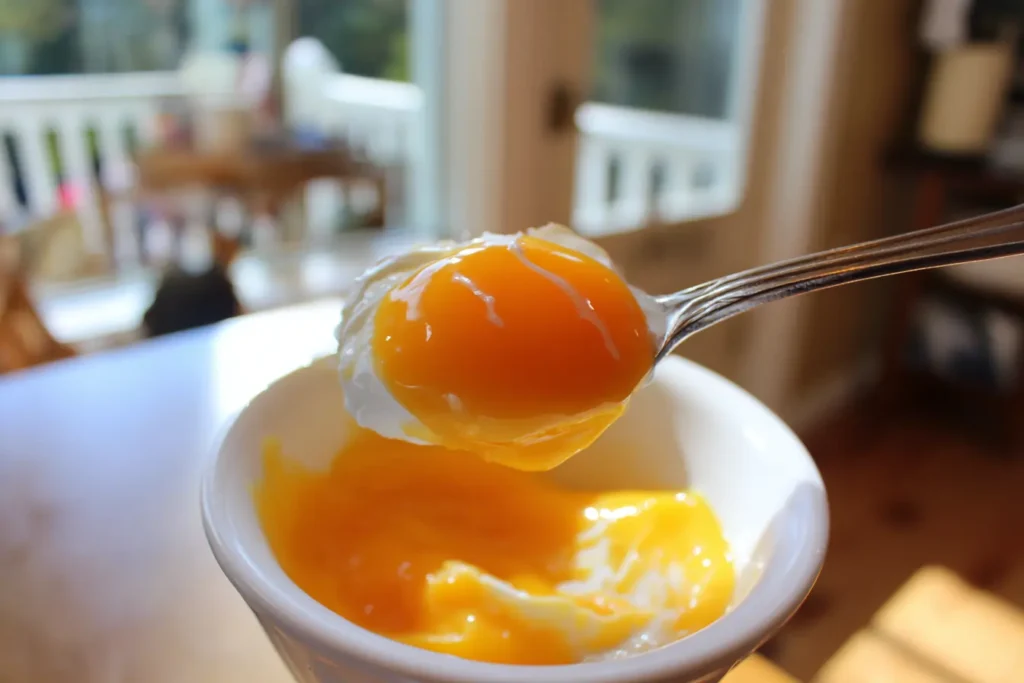
Clementine Curd Variations
Once you’ve made the classic version, these quick variations help you adapt the curd to different needs—without changing the method.
Small-Batch Clementine Curd (1 Jar)
Perfect if you only have a few clementines or want a small amount.
- Simply halve all the ingredients
- The method stays the same
- Watch closely—small batches thicken faster
Extra-Thick “Bakery-Style” Clementine Curd
Best for desserts that need structure.
- Use more egg yolks instead of whole eggs
- Cook just until it reaches a thicker spoon-coating stage
Great for cake layers, tarts, and sandwich cookies.
Vegan Clementine Curd (Egg-Free)
A simple egg-free option with a different texture.
- Thickened with cornstarch
- Sets firmer as it chills
- Stop cooking slightly looser than the classic version
Best for jars, tart fillings, and dairy-free desserts.
Nutrition Information
Clementine curd is meant to be enjoyed in small, satisfying amounts. It’s rich, citrusy, and flavorful—so you don’t need much to make a dish feel special.
Nutrition Per Serving (Approximate)
Based on 1 tablespoon of classic clementine curd.
| Nutrient | Amount |
|---|---|
| Calories | ~75 kcal |
| Carbohydrates | ~8 g |
| Sugar | ~7 g |
| Fat | ~5 g |
| Protein | ~1 g |
Values may vary depending on the amount of sugar, butter, and whether whole eggs or yolks are used.
Is Clementine Curd Healthy?
Clementine curd isn’t an everyday staple—and it’s not trying to be. It’s a flavor enhancer, used in small portions to add brightness and richness.
- Eggs contribute protein and fat-soluble nutrients
- Clementines add natural citrus compounds and flavor
- The key is portion size, not restriction
According to nutrition guidance from Harvard T.H. Chan School of Public Health, eggs can be part of a balanced diet when enjoyed in moderation, especially when cooked gently and paired with whole foods.
Dietary Notes
| Diet | Suitable? |
|---|---|
| Vegetarian | ✅ Yes |
| Gluten-Free | ✅ Yes |
| Dairy-Free | ⚠️ Vegan version only |
| Vegan | ⚠️ Vegan version only |
For general food safety and egg-based spread handling, refrigeration guidelines from the USDA apply.
12 Delicious Ways to Use Clementine Curd

Clementine curd is one of those recipes that quietly upgrades everything it touches. A small spoonful adds brightness, richness, and that “wow, what is this?” moment.
Breakfast Ideas (Fast & Cozy)
Perfect for slow mornings or quick treats:
- Swirled into yogurt bowls
- Spread on toast or English muffins
- Spoon over pancakes or waffles
- Served with warm scones (try it with my Scones Recipe)
- Dolloped onto oatmeal for a citrus lift
👉 It’s especially good with buttery baked goods, like scones or muffins, where the citrus really shines.
Dessert Ideas (Where It Really Shines)
Clementine curd works beautifully as a filling, topping, or swirl:
- Tart or pie filling using my Graham Cracker Crust
- Layered into cakes (chocolate and citrus are a dream together)
- Spoon-filled thumbprint cookies instead of jam
- Swirled into cheesecake or mousse
- Paired with crisp meringue for pavlova
If you love elegant, small desserts, it’s incredible in White Chocolate Mousse Tartlets as a citrus contrast.
Baking Performance Guide
Use this quick guide to choose the right application:
| Use | Works Well? | Notes |
|---|---|---|
| Spreading | ✅ Yes | Soft and spoonable |
| Cake filling | ✅ Yes | Use thicker or bakery-style version |
| Tart filling | ✅ Yes | Sets nicely when chilled |
| Swirling into batter | ⚠️ Sometimes | Best added gently |
| High-heat baking | ❌ No | Add after baking |
What to Make Next
If you have extra curd, try it in:
- Jam Crumb Bars (swap curd for jam)
- Mini Banana Bread Loaves as a topping
- homemade Buttermilk English Muffins for a bright breakfast twist
Clementine curd doesn’t need a special occasion — it creates one.
Frequently Asked Questions About Clementine Curd
What is clementine curd made of?
Clementine curd is made from clementine juice and zest, sugar, eggs (or egg yolks), butter, and a pinch of salt. The mixture is gently cooked until thick and silky.
Can I use mandarins, satsumas, or tangerines instead?
Yes. Clementines, mandarins, satsumas, and tangerines all work. The only difference is sweetness and acidity, so you may need to slightly adjust the sugar or add a small splash of lemon juice.
Do I need a double boiler to make clementine curd?
No. A single saucepan over low heat works perfectly as long as you whisk constantly and avoid boiling.
How thick should clementine curd be when it’s done?
It should coat the back of a spoon and hold a clean line when you run your finger through it. It will thicken more as it cools.
Can I make clementine curd without butter?
Yes. The vegan version skips butter and eggs, using cornstarch and plant milk instead. The texture will be slightly firmer and more pudding-like.
A Little Final Note 💛
Clementine curd is one of those recipes that feels quietly special. It doesn’t ask for fancy tools or perfect timing—just a little patience, a whisk, and a love for citrus. Whether you spoon it onto toast, swirl it into desserts, or eat it straight from the jar (no judgment here), I hope it brings a bit of brightness into your kitchen.
If you make it, trust your instincts, taste as you go, and enjoy the process. That’s where the real magic is.
for more recipes follow me in Facebook, Pinterest and medium.