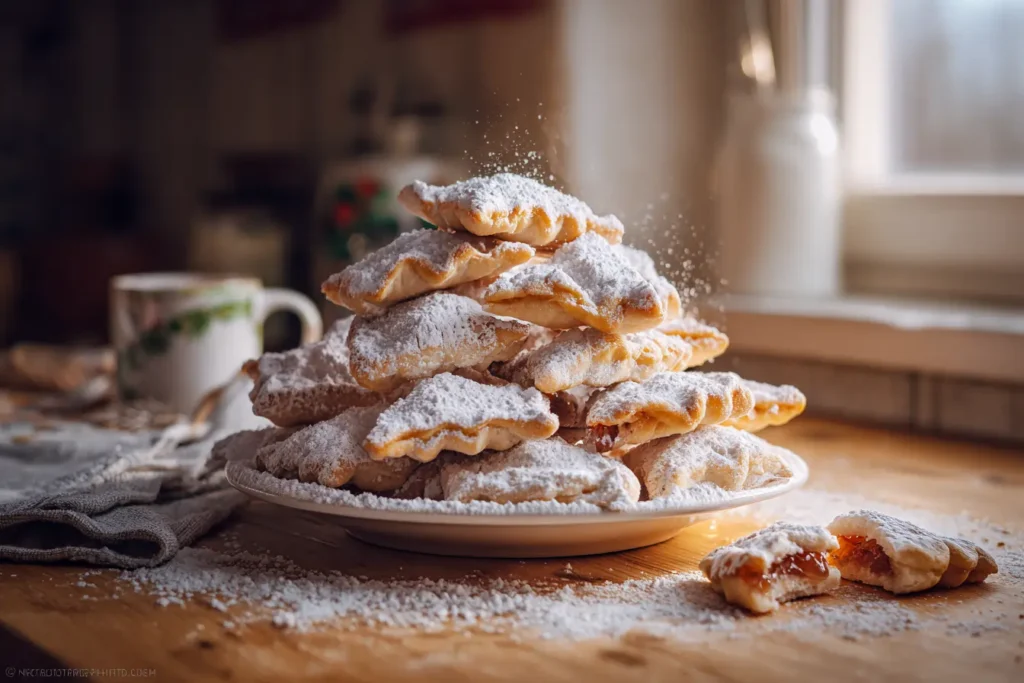
The first time I made Polish kolaczki, I was feeling so confident… like “holiday-cookie-queen” confident. Then I pulled the tray out of the oven and—how do I say this nicely—my cookies chose chaos. Corners popped open, jam bubbled out, and my baking sheet looked like a tiny crime scene sprinkled with powdered sugar.
Naturally, I took it personally. I’m the kind of woman who drinks coffee in one hand and whisks butter in the other, and I refuse to be publicly disrespected by a cookie. So I started testing: colder dough, thicker fillings, different ways to pinch the corners like I was sealing a secret. My kitchen smelled like buttery goodness for days, and honestly? I was living my best life.
Now I’m sharing the version I trust for cookie trays, gifting, and those “wait… you MADE these?” moments—Polish kolaczki that stay closed, don’t leak everywhere, and taste like the cozy holiday memory you’re chasing.
Table of Contents
Table of Contents
Polish kolaczki: what they are (and aren’t)
Polish kolaczki are tender, buttery kolaczki cookies made with a simple cream cheese dough, folded around a sweet filling, then baked and dusted with powdered sugar. When people search for Polish kolaczki, they’re usually craving that classic holiday cookie vibe: soft, delicate, and just sweet enough—with a little “jewel” of filling in the center (apricot, raspberry, poppy seed, or prune/powidła).
What are Polish kolaczki cookies?
Think of Polish kolaczki cookies as the cozy cousin of a pastry—like a mini cookie-turnover, but way easier. The dough is typically cream cheese + butter + flour, which gives kolaczki that rich, melt-in-your-mouth texture without yeast or complicated steps. And if you’re the kind of person who has a soft spot for jam-filled desserts, these Polish kolaczki are basically calling your name.
Kolaczki vs kolache vs kolacky (quick and clear)
This is where the internet gets messy:
- Kolaczki = folded cookies with filling inside (what we’re making: Polish kolaczki)
- Kolache = usually a yeasted pastry, often open-faced in the center
- Kolacky / kolachky = common spelling variations people use when they mean kolaczki cookies
So if you want the folded, powdered-sugar holiday cookies, you want Polish kolaczki.
How to say it + spelling (kołaczki)
You may see the Polish spelling kołaczki. Don’t stress it—most recipes and searches use “Polish kolaczki,” and that’s perfectly fine.
Why Polish kolaczki are a holiday cookie tray favorite
Polish kolaczki cookies look fancy with almost zero effort. They stack beautifully, travel well, and give major “bakery cookie tin” energy. They’re right at home next to other holiday cookie favorites—especially with that powdered sugar “snow” on top.
Quick Start: the 3 fail-proof rules (read this first)
Before we start, here’s the truth: Polish kolaczki are easy when you follow three rules. Break them and you’ll get pop-open corners, leaky filling, or dough that turns sticky at the worst possible time.
Rule #1 — Keep the dough cold
Cold dough is easier to roll, cut, and seal.
Tip: work with half the dough at a time and keep the rest in the fridge.
Rule #2 — Use thick filling (the spoon test)
Scoop filling and tilt the spoon:
- Good: it holds or slowly slides
- Bad: it drips → it will leak
Rule #3 — Seal firmly (with overlap)
Fold corners with a small overlap, then pinch where the dough overlaps (not just the tips). A firm seal = kolaczki that stay closed.
How much filling per cookie?
Use about ½ teaspoon per cookie. Too much filling expands in the oven and forces the cookie open.
Filling Reliability Chart (best fillings + what to avoid)
Let’s save your baking sheet from the Great Jam Disaster. For Polish kolaczki, the best filling is the one that’s thick, stable, and not overly watery. Here’s the simple rule: if it drips off a spoon like syrup, it’s going to leak.
Best fillings for Polish kolaczki (quick chart)
- Cake/pastry filling (like Solo) — Leak risk:
Best for beginners. Thick, stable, easy to use. - Thick preserves — Leak risk:
Works well if it’s chunky/thick (not runny). - Jam (regular jar jam) — Leak risk:
Can work, but it’s the most likely to bubble out unless thickened. - Poppy seed filling — Leak risk:
Traditional and very stable. - Prune filling / powidła (plum butter) — Leak risk:
Traditional, rich, and usually thick enough. - Sweet cheese filling — Leak risk:
Tasty, but needs to be thick (not wet).
Jam vs preserves vs pastry filling (why jam leaks)
Jam often has more free liquid, and that liquid heats up and boils in the oven. That bubbling pressure is what pushes your kolaczki open. Pastry filling is designed to bake without running—so it’s usually the easiest “no-drama” choice for Polish kolaczki cookies.
How to fix runny jam (fast!)
If jam is all you have, do one of these quick fixes:
- Stovetop reduce: simmer 3–5 minutes, then cool completely.
- Cornstarch option: warm jam and whisk in a tiny slurry, then cool.
- Cool = thicker: even thick jam leaks if it goes into the dough warm.
Polish Kolaczki
- Total Time: 40 minutes
- Yield: About 30 cookies 1x
- Diet: Vegetarian
Description
Polish kolaczki are tender cream cheese dough cookies folded around a thick fruit (or traditional) filling, baked until lightly golden, then dusted with powdered sugar for a classic holiday-cookie finish.
Ingredients
For the dough
-
8 oz (226g) full-fat cream cheese, cool/room temp (not warm)
-
1 cup (226g) unsalted butter, cool/room temp (not melted)
-
2 cups (250g) all-purpose flour, plus more for rolling
-
1/4 tsp fine salt
-
1 tsp vanilla extract (optional)
For filling + finish
-
3/4 cup thick pastry filling or thick preserves (apricot/raspberry/poppy seed/powidła), chilled if possible
-
Powdered sugar, for dusting
Instructions
-
Make the dough: In a large bowl, beat cream cheese and butter until smooth. Add salt (and vanilla, if using). Mix in flour just until a soft dough forms (don’t overmix).
-
Chill: Flatten dough into a disc, wrap, and chill at least 1 hour (or until firm).
-
Prep: Heat oven to 350°F (175°C). Line baking sheets with parchment.
-
Roll + cut: Roll dough on a lightly floured surface to 1/4 inch thick (easiest) or 1/8 inch (more delicate). Cut into 2 to 2½-inch squares.
-
Fill: Place about 1/2 teaspoon filling in the center of each square.
-
Fold + seal: Fold two opposite corners over filling so they overlap slightly. Pinch firmly at the overlap (use a tiny dab of water if needed).
-
Bake: Bake 12–15 minutes, until bottoms are lightly golden and tops look set.
-
Cool + dust: Cool 10 minutes, then dust with powdered sugar. Dust again right before serving for the prettiest “snowy” look.
Notes
-
Best filling: Thick pastry/cake filling is the most reliable. If using jam, choose the thickest one and don’t overfill.
-
#1 success rule: Keep dough cold. If it gets soft while working, chill it 10–15 minutes.
-
Seal tip: Pinch where the dough overlaps (not just the tips).
-
Powdered sugar tip: Dust when cookies are warm-but-not-hot so it doesn’t melt.
- Prep Time: 25 minutes
- Cook Time: 12–15 minutes
- Category: Dessert
- Method: Baking
- Cuisine: Polish
Nutrition
- Serving Size: 1 cookie
- Calories: 120
- Sugar: 6g
- Sodium: 55mg
- Fat: 7g
- Saturated Fat: 4g
- Unsaturated Fat: 2g
- Trans Fat: 0g
- Carbohydrates: 14g
- Fiber: 0.5g
- Protein: 1.5g
- Cholesterol: 18mg
Ingredients + tools (with substitutions that work)
You don’t need anything fancy to make Polish kolaczki—but you do need the basics to be the right texture (cold dough + thick filling = happy cookies).
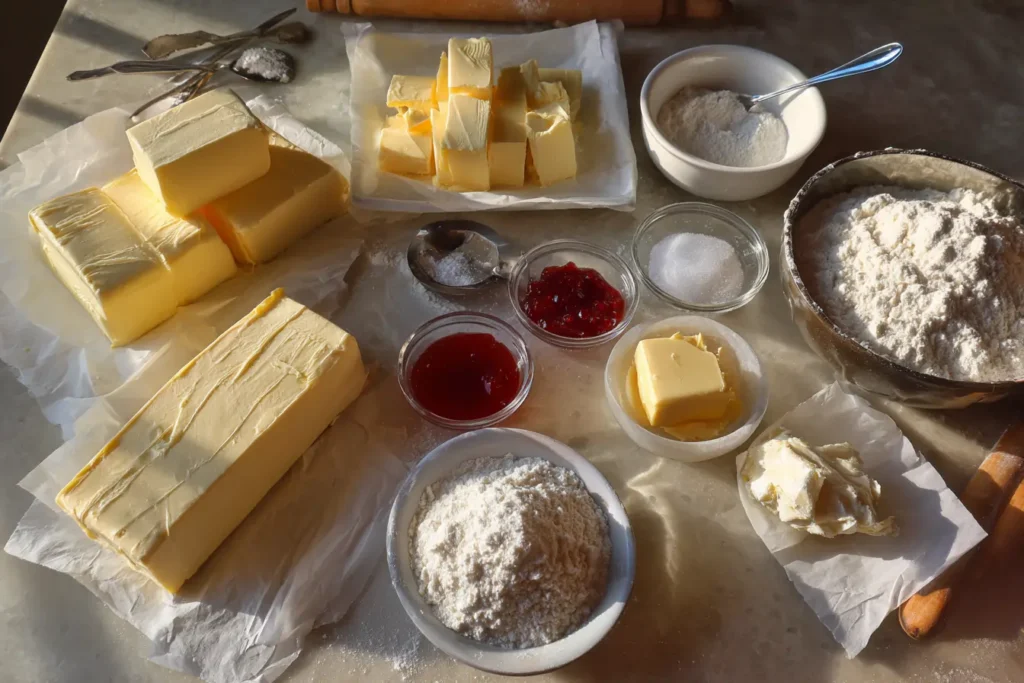
Ingredients (simple + classic)
- Cream cheese (full-fat works best for rich, tender dough)
- Butter (unsalted preferred; if salted, just reduce added salt)
- All-purpose flour
- Pinch of salt
- Filling (pastry filling, thick preserves, poppy seed, powidła, etc.)
- Powdered sugar (for the “snow” on top)
Optional flavor boosts (small but lovely):
- Vanilla extract
- Lemon or orange zest
- Tiny pinch of cinnamon (especially with prune/powidła)
Best ingredient temperature (this matters!)
- Cream cheese + butter should be cool, not melty.
If they’re too warm, the dough gets sticky fast and your kolaczki won’t hold a seal.
Quick fix: if the dough feels soft or shiny, chill it 15–20 minutes before rolling.
Easy substitutions (that won’t ruin the batch)
- Salted butter: OK—just use a smaller pinch of salt.
- Filling options: pastry filling is easiest; thick jam/preserves can work.
- Flour: stick to all-purpose for best results (gluten-free blends can change texture and sealing).
Tools that make Polish kolaczki easier (no stress)
- Rolling pin
- Pizza cutter or sharp knife (for neat squares)
- Small spoon or ½ tsp measure (keeps filling consistent)
- Parchment paper (less sticking, easier cleanup)
- Baking sheet + cooling rack
Step-by-step Polish kolaczki recipe
This is the part where your kitchen starts smelling like butter and holiday magic. Keep your dough cold, your filling thick, and your sealing confident, and these Polish kolaczki will behave beautifully.
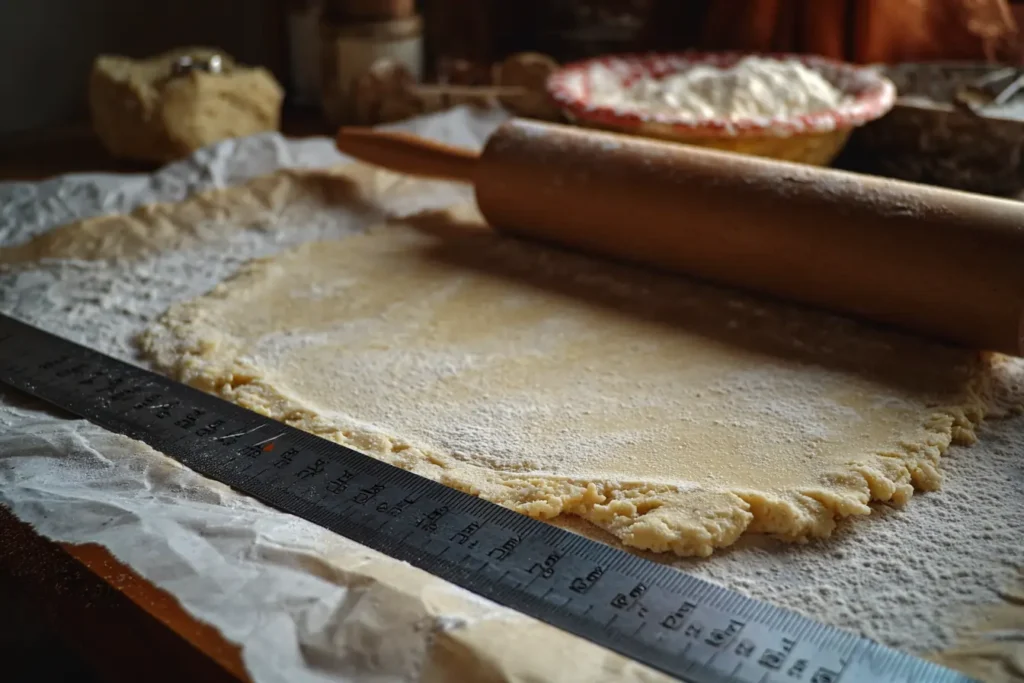
Step 1 — Make the dough (what it should feel like)
Mix the dough until it comes together and looks smooth and soft, but not sticky.
How to know it’s right: you should be able to press it with a finger and it holds shape instead of smearing.
Mini tip: If it feels warm or greasy, cover and chill before you do anything else.
Step 2 — Chill + prep (how long is enough?)
Chill the dough until it’s firm—this makes rolling and cutting clean.
If you have time, a longer chill is even better (and less mess).
Set up while it chills: line a baking sheet with parchment and have your filling ready (cool + thick!).
Step 3 — Roll + cut (1/8″ vs 1/4″ thickness guide)
Roll dough on a lightly floured surface:
- 1/8 inch: more delicate, bakery-style (best once you’re confident)
- 1/4 inch: easier to handle and seal (best for beginners)
Cut into squares (about 2 to 2½ inches is a great size for classic Polish kolaczki cookies).
Step 4 — Fill, fold, and seal (3 methods)
Add filling to the center: about ½ teaspoon.
Then fold two opposite corners toward the center so they overlap slightly and seal using one of these:
- Method A: Dry pinch
Pinch the overlap firmly. - Method B: Water dab
Tiny dab of water where the corners meet, then pinch. - Method C: Tiny egg-wash dab
Best if your kitchen is warm or your dough is a little soft.
Goal: the corners should look “stuck,” not just resting.
Step 5 — Bake, cool, and dust with powdered sugar
Bake until the bottoms are lightly golden and the tops look set. Cool, then dust generously with powdered sugar.
Powdered sugar tip: wait until cookies are warm-but-not-hot so it doesn’t melt into a glaze.
Variations (shapes + flavor upgrades)
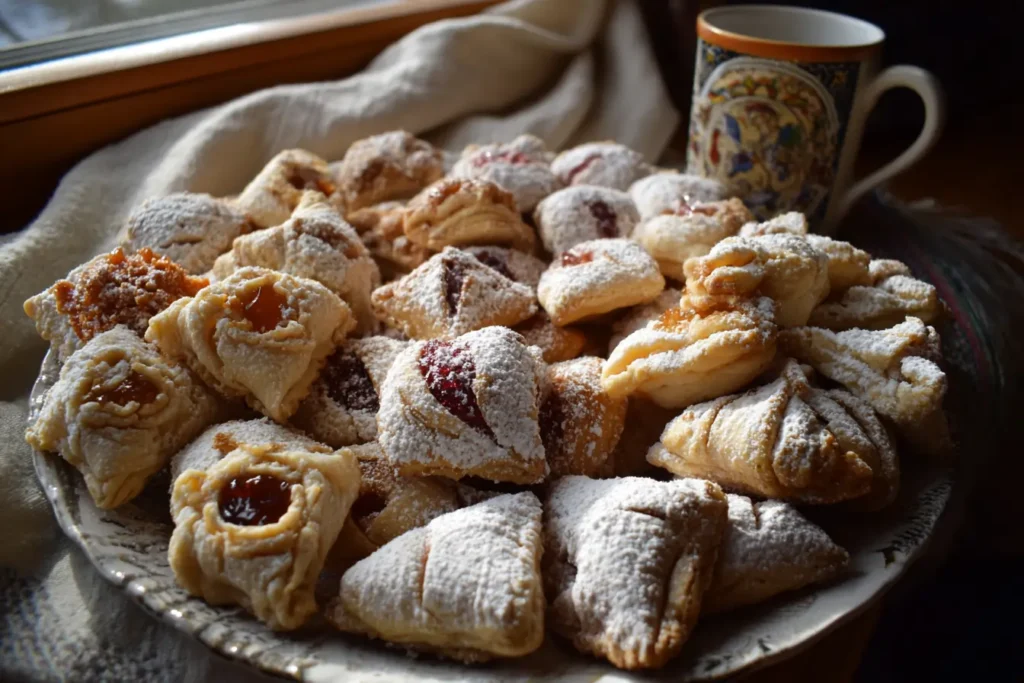
Once you’ve got your Polish kolaczki sealing like a pro, this is where the fun starts. The best part about Polish kolaczki cookies is that you can switch up the shape and flavor without changing the core method—cold dough, thick filling, strong seal.
Shape guide: envelope vs pinwheel vs diamond (for Polish kolaczki)
Different shapes look cute, but they don’t all behave the same—and with Polish kolaczki, “behave” means stay closed and don’t leak.
- Envelope (classic Polish kolaczki fold)
The most reliable shape for Polish kolaczki cookies. Great for beginners because the overlap seals well. - Pinwheel (corners folded to the center)
Pretty, but Polish kolaczki in this shape can pop open if the dough gets warm or the filling is runny. - Diamond (two corners folded toward center)
A simple, elegant look for kolaczki cookies, especially with thick fillings like pastry filling or poppy seed.
Quick tip for Polish kolaczki: If you’re using jam, stick with the envelope fold—less leaking and fewer pop-open corners.
Flavor the dough (small upgrades that still work)
You can flavor Polish kolaczki dough without messing up the texture—just keep it subtle:
- Vanilla extract (classic bakery-style Polish kolaczki)
- Orange or lemon zest (amazing in Polish kolaczki with apricot or raspberry)
- Almond extract (tiny amount = big “fancy cookie tray” energy)
Filling combos that always win (for Polish kolaczki cookies)
- Apricot + almond (classic Polish kolaczki vibe)
- Raspberry + lemon zest (bright, fresh, pretty)
- Poppy seed + orange (traditional-style Polish kolaczki filling)
- Prune/powidła + vanilla (deep, cozy, very “old-world”)
Small batch / big batch scaling (12 / 24 / 48 Polish kolaczki)
If you’re baking Polish kolaczki cookies for a tray or gifting, scaling matters:
- 12 Polish kolaczki: perfect test batch
- 24 Polish kolaczki: standard home batch
- 48 Polish kolaczki: holiday baker mode
Consistency tip: Use a ½ teaspoon measure for every cookie—uniform Polish kolaczki look better and seal better.
Nutrition details (per serving)
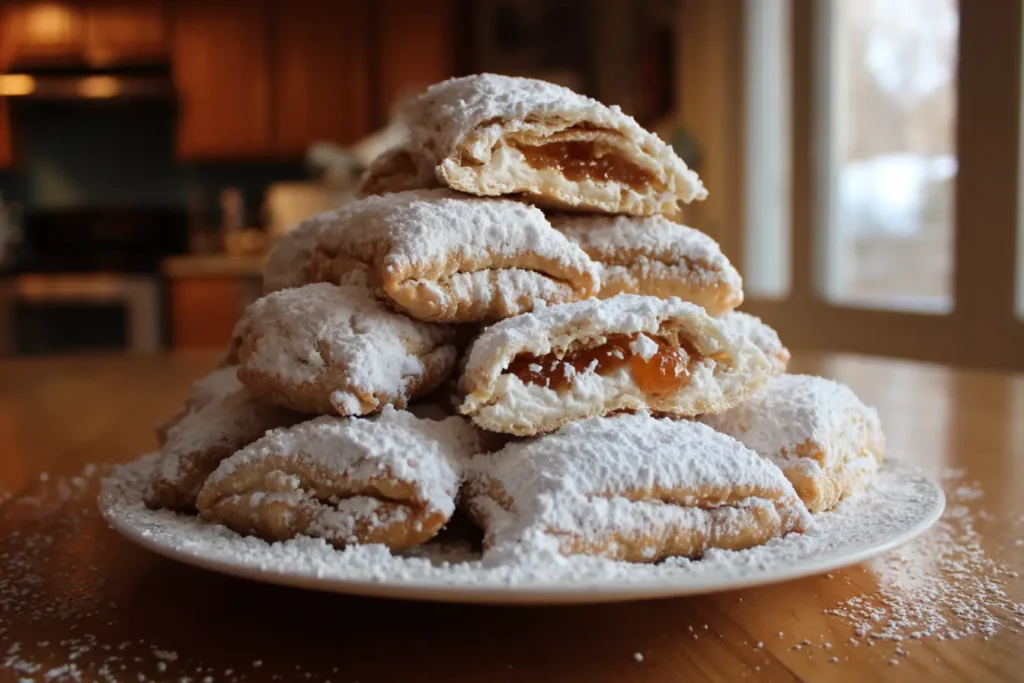
Polish kolaczki cookies are a treat (but a very worth-it one 😄). Since cookie size + filling choice changes everything, it’s better to give a realistic range—and remind readers that nutrition facts are always tied to a serving size (here’s the FDA’s quick guide on how Nutrition Facts work: U.S. Food and Drug Administration
Approximate nutrition per cookie (typical range)
| Cookie size + filling style | Calories | Carbs | Sugar | Fat | Protein |
|---|---|---|---|---|---|
| Small (light dusting, thick pastry filling) | 80–110 | 9–14g | 3–6g | 4–7g | 1–2g |
| Standard (½ tsp filling + powdered sugar) | 100–140 | 12–18g | 5–9g | 6–9g | 1–2g |
| Large / extra filling / heavy sugar | 140–190 | 18–26g | 9–16g | 8–12g | 2–3g |
If you want to calculate your exact numbers (based on your specific cream cheese, butter, flour, and filling), you can pull ingredient nutrition straight from USDA FoodData Central.
Frequently Asked Questions (FAQ’s)
What are Polish kolaczki cookies?
Polish kolaczki cookies are tender cream cheese dough cookies folded around a sweet filling, baked, and usually dusted with powdered sugar. They’re a classic holiday cookie because they look fancy but they’re actually very doable at home.
Are kolaczki and kolache the same thing?
No. Polish kolaczki are typically folded cookies with filling inside, while kolache are usually yeasted pastries (often with an open center). The names get mixed online, but the textures and methods are different.
Why do Polish kolaczki pop open sometimes?
Usually one of these: the dough was too warm, the filling was too runny, or the corners weren’t overlapped and pinched firmly enough. Cold dough + thick filling + a strong pinch solves most “pop-open” problems.
What filling is best for Polish kolaczki?
The easiest, most reliable option is thick cake/pastry filling. Thick preserves also work well. Regular runny jam leaks more often unless you thicken it first.
How thick should Polish kolaczki dough be?
For beginners, roll Polish kolaczki dough about ¼ inch thick (easier to fold and seal). For a more delicate, bakery-style cookie, roll closer to ⅛ inch—but it’s less forgiving.
Conclusion
If you remember nothing else, remember this: cold dough, thick filling, and a confident seal are the whole secret to Polish kolaczki that stay closed (and keep the filling where it belongs—in the cookie 😅).
Make a small test tray first, then bake the rest like you own the kitchen. And when you pull out that powdered-sugar-perfect batch, please come back and tell me which filling you chose—because I’m nosy in the sweetest way.
for more recipes follow me in Facebook, Pinterest and medium.