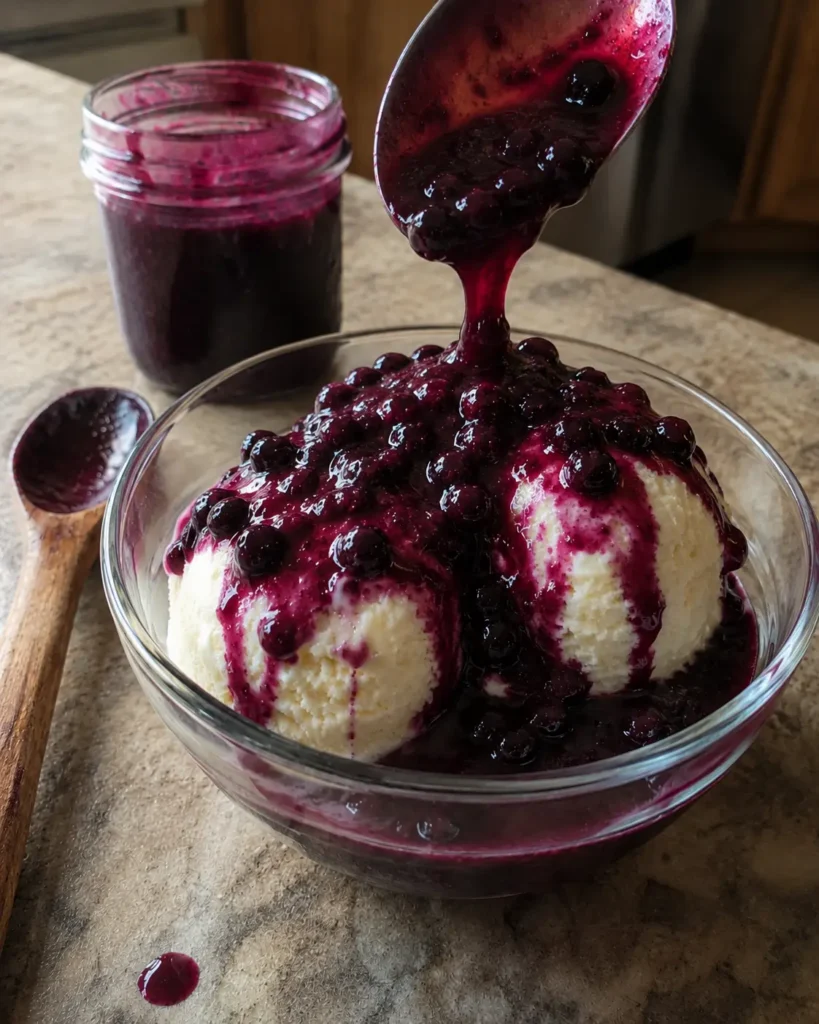
If you’ve got two cups of huckleberries and fifteen minutes, you’ve got dessert handled. This Homemade Huckleberry Sauce turns wild berries into a glossy, deep-purple topping that’s sweet enough to feel like a treat and tart enough to taste like the mountains it came from.
Huckleberries are stubborn little things. They won’t grow on a farm, they show up for maybe six weeks a year, and if someone hands you a bag, you don’t waste them. A sauce is the smartest use — it stretches a small haul across a whole week of breakfasts and desserts.
The best part is how forgiving it is. There’s exactly one decision to make (thin or thick), and the recipe tells you when to make it. No pectin, no candy thermometer, no guessing.
Save this one for the week after a picking trip, when you need something simple, cozy, and family-friendly.
Quick Recipe Snapshot – Homemade Huckleberry Sauce
- Prep time: 5 minutes
- Cook time: 15 minutes
- Total time: About 50 minutes (includes 30 minutes cooling)
- Servings: 12 (2 tablespoons each) — makes about 1½ cups
- Difficulty level: Easy — a true beginner recipe
- Best for: Pancakes, waffles, ice cream, cheesecake, yogurt, scones, pork
- Main method: Stovetop simmer
- Flavor profile: Sweet-tart, bright, deeply fruity, faintly wild and piney
Table of Contents
Table of Contents
Why You’ll Love This Homemade Huckleberry Sauce
- Five ingredients, and you own four of them already. Sugar, water, lemon, salt. The berries are the only special part.
- Frozen berries work exactly as well as fresh. No thawing. Straight from the bag into the pot.
- It’s nearly impossible to ruin. Undercook it and you have syrup. Overcook it and you have jam. Both are delicious.
- One pot, one spoon. Cleanup is thirty seconds.
- It makes an ordinary Tuesday feel like something. Plain yogurt with this Homemade Huckleberry Sauce on top is a different breakfast entirely.
- It gifts beautifully. A small jar with a ribbon is a real present, and it costs almost nothing.
What Makes This Homemade Huckleberry Sauce Work
Huckleberries are naturally tart and naturally full of pectin — the same stuff that makes jam set. That’s the whole secret. You aren’t adding thickener so much as coaxing out what’s already inside the fruit.
Here’s the chain of events in the pot. Sugar pulls juice out of the berries. Heat breaks their skins so more juice escapes. That juice, plus the pectin riding along with it, reduces down and starts to grip. The lemon juice does double duty: it brightens flavor and gives the pectin the acidity it needs to actually set.
The pinch of salt does something small but real. It doesn’t make anything salty — it just sharpens the fruit so the berry flavor reads clearer instead of tasting flat and sugary.
And why is this berry worth the trouble? Because you can’t buy it fresh at a grocery store. Wild huckleberries resist domestication, which is why the Forest Service allows personal-use picking on national forest land but treats the bushes as a shared resource. Every jar you make came from someone crouching in a mountain clearing.
Ingredients You’ll Need
2 cups huckleberries (fresh or frozen)
The star, and the only non-negotiable. Frozen go in still frozen — they’ll just need an extra minute or two. If fresh, pick through and pull out any stems, leaves, or shriveled berries first.
½ cup granulated sugar
Not just for sweetness. Sugar draws juice out of the berries and gives the finished sauce its glossy body. Half a cup is deliberately middle-of-the-road — enough to balance wild huckleberry tartness without burying it.
¼ cup water
Just enough to get things moving before the berries release their own juice, so nothing scorches in the first two minutes. Resist adding more; extra water means a longer simmer and a thinner result.
1 tablespoon fresh lemon juice
Brightens the flavor and helps the natural pectin set. Fresh is noticeably better than bottled here — bottled reads slightly flat.
⅛ teaspoon salt
Small, but it makes the berry taste more like itself.
Optional: 1 tablespoon cornstarch + 2 tablespoons cold water
Your thickening insurance. Only if you want it spoonable tonight instead of tomorrow.
Optional: ½ teaspoon vanilla extract
Stirred in off the heat. Rounds the edges and makes it taste a little more like dessert.
Ingredient Notes and Easy Swaps
Sugar: Brown sugar works and adds a warm molasses note — nice in fall, a little muddying in summer. Half white and half brown is a good compromise. Honey or maple syrup will work but both add flavors that compete with the huckleberry, and honey especially can taste louder than the fruit.
Berries: No huckleberries? Wild blueberries are the closest relative and cook down almost identically — smaller and more intense than regular blueberries. Regular blueberries work too, but they’re sweeter, so drop the sugar to ⅓ cup.
Don’t skip the lemon. This is the one swap that matters. Without acid the sauce tastes cloying and the set is looser. If you’re out of lemons, lime works, or 2 tablespoons of orange juice — though orange is sweeter, so it changes the balance.
Cornstarch: Tapioca starch or arrowroot substitute one-for-one. If you want to see this technique used differently, our blackberry curd leans on eggs instead of starch for a much richer texture.
How to Make Homemade Huckleberry Sauce
- Prep the berries. If fresh, rinse in a colander and pick out stems, leaves, and any berries that look shriveled or dull. If frozen, skip this — go straight to the pot.
- Combine everything except the cornstarch. Add berries, sugar, water, lemon juice, and salt to a 2-quart saucepan. Stir once. It’ll look dry and unpromising. That’s normal.
- Bring it up over medium heat. In about 3–4 minutes you’ll see juice pooling around the berries and the mixture will start to bubble at the edges. Frozen berries take a minute or two longer.
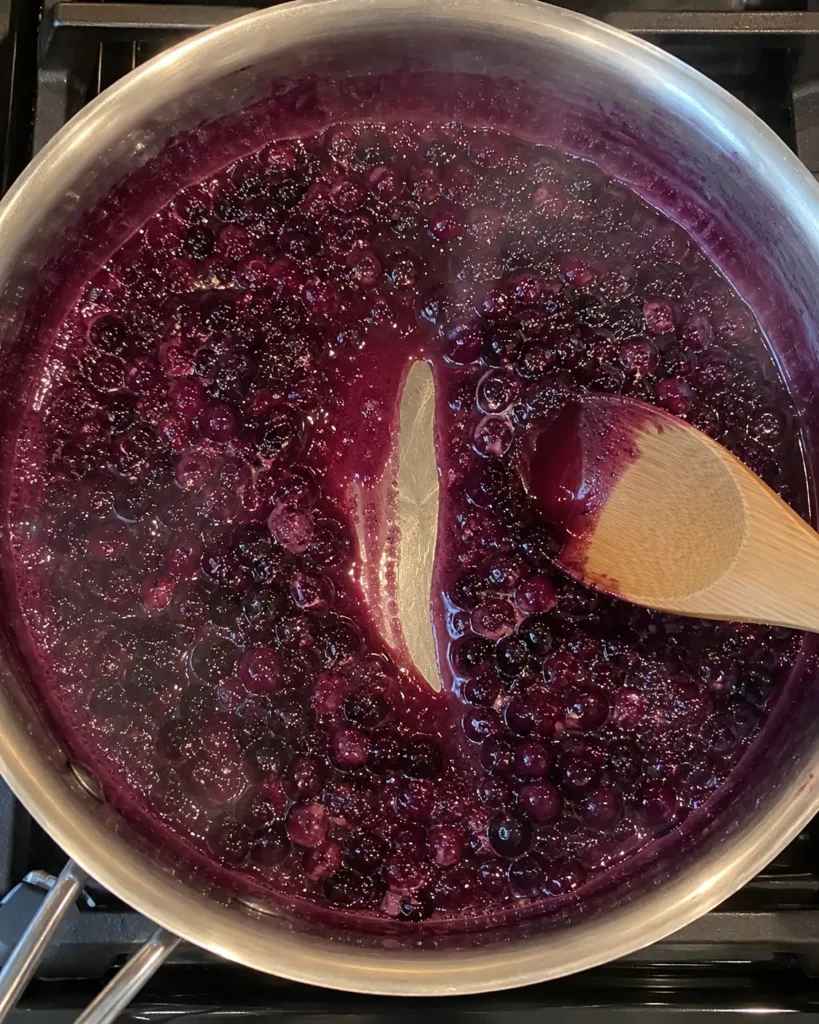
- Drop to medium-low and simmer 10–12 minutes. Stir every couple of minutes. Around minute five, press about a third of the berries against the side of the pot with the back of your spoon — you’ll hear them pop and see the color go from spotty purple to a uniform deep violet. Leave the rest whole for texture.
- Check the doneness cue. Drag your spoon through the center of the pot. If the sauce takes a beat to flow back into the gap, it’s ready. If it rushes back instantly, give it 2–3 more minutes.
- Taste it. Now, not before. If it’s too tart, stir in another tablespoon of sugar. This is your one real decision.
- Thicken, if you want to. For a thicker sauce right now: whisk the cornstarch into the cold water until no lumps remain, pour it in while stirring, and cook 2 more minutes. It’ll go from cloudy to glossy — that’s your sign it’s cooked through. Skip this entirely if you like it syrupy.
- Cool it down. Off the heat, stir in vanilla if using. Let it sit 30 minutes before serving warm. It will look too thin in the pan — trust it. It keeps thickening as it cools, and it hits full body after about 2 hours in the fridge.
Beginner Tips for Best Results
- Use a light-colored pot if you have one. Against stainless steel you can actually see the color deepen. In a dark pot you’re flying blind.
- Never add cornstarch straight to hot liquid. It’ll seize into lumps you can’t whisk out. Cold water first, always.
- Stop pressing at about a third of the berries. Whole berries bursting on a pancake are the whole point. Mash everything and you’ve made syrup.
- Medium-low means lazy bubbles, not a rolling boil. A hard boil scorches the sugar at the bottom before the berries have finished giving up their juice.
Common Mistakes to Avoid – Homemade Huckleberry Sauce
Judging thickness while it’s hot. This is the number one reason people over-thicken. Hot sauce is always thinner than cool sauce. If it looks right in the pan, it’ll be too stiff by morning.
Adding sugar at the start and hoping. Berry tartness swings wildly depending on ripeness and elevation. Taste at minute ten and adjust then, when you actually know what you have.
Walking away. Fifteen minutes isn’t long, and sugar at the bottom of a pan goes from fine to burnt in under a minute. Stay nearby.
Doubling the batch in the same pot. More depth means slower evaporation and a soupy result. Use a wider pan, or make two batches.
Easy Variations
- Warmer: ¼ teaspoon cinnamon plus a pinch of nutmeg, added with the sugar. Excellent in fall.
- Brighter: Add the zest of half a lemon in the last minute. Sharpens everything.
- Kid-friendly: Bump sugar to ⅔ cup and mash all the berries — no surprise textures, and it pours cleanly.
- Lighter: Drop to ⅓ cup sugar and add an extra teaspoon of lemon. Tarter, more grown-up, better on savory food.
- Grown-up: A tablespoon of bourbon off the heat.
- Thicker, like a fruit butter: Simmer 20 minutes instead of 12 and mash everything. You’ll get close to the texture of our Amish peach butter.
- Thinner, like a syrup: Add ¼ cup more water, skip the cornstarch, and strain. Similar in spirit to our lemon ginger honey syrup, which is lovely stirred into sparkling water.
What to Serve With Homemade Huckleberry Sauce
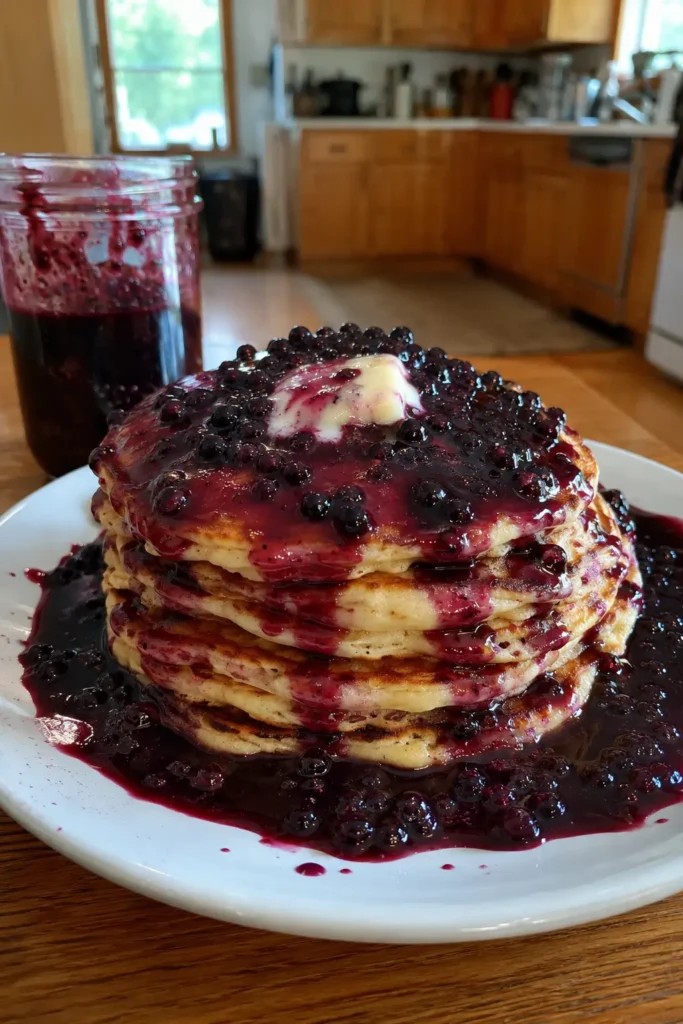
Breakfast is the obvious home. Spoon it over a stack of lemon blueberry pancakes — the lemon in the batter echoes the lemon in the sauce and the whole plate clicks. It’s equally good over a blueberry pancake casserole if you’re feeding a crowd and don’t want to stand at the griddle.
Warm, split scones with butter and a spoonful of this are close to perfect.
For dessert, vanilla ice cream is the classic — the cold-and-warm contrast is the entire appeal. It’s also gorgeous over something floral like our creamy rose pistachio ice. And a cheesecake wants exactly this: try it over a slice of peach cobbler cheesecake for a summer-fruit pile-on.
Don’t overlook savory. A spoonful alongside roast pork or seared duck does what cranberry sauce does at Thanksgiving, only better.
Make-Ahead Tips
This is a make-ahead recipe by nature — it’s genuinely better on day two, once the flavors settle and the texture finishes setting.
Make it Sunday afternoon and you’ve bought yourself a week of easy breakfasts. You can also freeze picked-over berries in a zip-top bag right after a harvest and make sauce whenever you want, straight from frozen.
How to Store Homemade Huckleberry Sauce
Cool completely, then transfer to a clean jar or airtight container. It keeps 1 to 2 weeks in the refrigerator. Toward the end of week two it’s still safe but the brightness fades — the lemon flattens out.
Always use a clean spoon. Double-dipping with a used one is the fastest way to shorten its life.
An important honest note about canning. Please don’t water-bath this Homemade Huckleberry Sauce for shelf storage. It’s built as a refrigerator sauce, and its exact sugar-to-acid ratio hasn’t been lab-tested for shelf stability. You’ll find bloggers who guess it’s probably fine — guessing isn’t good enough where botulism is concerned. If you want jars in the pantry, use a tested procedure instead: the National Center for Home Food Preservation’s directions for canning whole berries name huckleberries specifically and give verified processing times.
Can You Freeze Homemade Huckleberry Sauce?
Yes, and it freezes beautifully. Homemade Huckleberry Sauce keeps for up to 3 months in the freezer with almost no loss of flavor.
Cool it fully, then portion into small containers or jars — half-cup portions are the sweet spot, since you’ll rarely want more at once. Leave about half an inch of headspace; it expands.
One caveat: if you used cornstarch, the texture can turn slightly grainy or weepy after thawing. It’s still good, and a quick whisk while reheating pulls it back together. If you know you’re freezing it, consider skipping the slurry and thickening after you thaw.
Thaw overnight in the fridge.
How to Reheat
Stovetop (best): Low heat, stirring, 2–3 minutes. Add a teaspoon of water if it’s stiffened up more than you’d like.
Microwave (fine): 20-second bursts, stirring between. Don’t blast it for a minute straight — the edges scorch while the middle stays cold.
Serve it warm, room temperature, or straight from the fridge. All three are legitimate.
Nutrition Notes
A 2-tablespoon serving lands at roughly 50–60 calories, almost entirely from the fruit and sugar. Exact values depend on your berries, how much sugar you added after tasting, and how thick you cooked it down.
Huckleberries carry the things you’d expect from a dark berry — anthocyanins, some vitamin C, a little fiber. That said, this is a dessert topping with a half cup of sugar in it, and it’s fair to treat it as one. If you want to run your own numbers, USDA FoodData Central is the place to check.
Frequently Asked Questions – Homemade Huckleberry Sauce
Can I make Homemade Huckleberry Sauce with frozen huckleberries?
Yes — and there’s no penalty at all. Add them frozen, don’t thaw, and give the pot an extra minute or two to come up to a simmer. Frozen berries have already had their cell walls broken by ice crystals, so they often release juice faster than fresh.
Why is my huckleberry sauce still runny?
Almost always because you’re judging it hot. It thickens as it cools and reaches full body after about 2 hours chilled. If it’s genuinely too thin the next day, simmer it a few minutes longer or whisk in a cornstarch slurry.
Can I use blueberries instead of huckleberries?
Yes. Wild blueberries are the closest match. Regular blueberries work but are sweeter — cut the sugar to ⅓ cup.
Do I have to use cornstarch?
No. Huckleberries have enough natural pectin to set on their own with a longer simmer. Cornstarch just gets you there faster.
How long does huckleberry sauce last in the fridge?
1 to 2 weeks in a sealed container, using a clean spoon each time.
Can I can this sauce for the pantry?
Not safely, no. Use a tested canning procedure for berries instead — this Homemade Huckleberry Sauce is designed for the fridge and freezer.
Is huckleberry sauce good on savory food?
Very. It’s excellent with pork, duck, and game — sweet-tart fruit against rich meat is a classic pairing.
Final Thoughts – Homemade Huckleberry Sauce
There’s something worth respecting about a berry that refuses to be farmed. You only get huckleberries because someone went and found them.
This Homemade Huckleberry Sauce is the least complicated way to honor that — fifteen minutes, one pot, and a jar of something you can’t buy. Make it once and you’ll know the doneness cue by feel next time.
If you make it, come back and tell us how it went.
Print
Homemade Huckleberry Sauce
- Total Time: 50 minutes
- Yield: 12 servings (about 1½ cups) 1x
- Diet: Vegan
Description
This Homemade Huckleberry Sauce is sweet, tart, and ready in about 15 minutes on the stovetop. Made with just five simple ingredients and fresh or frozen huckleberries, it’s perfect over pancakes, waffles, ice cream, cheesecake, or yogurt.
Ingredients
2 cups huckleberries (fresh or frozen)
½ cup granulated sugar
¼ cup water
1 tablespoon fresh lemon juice
⅛ teaspoon salt
1 tablespoon cornstarch (optional, for a thicker sauce)
2 tablespoons cold water (optional, for the cornstarch slurry)
½ teaspoon vanilla extract (optional)
Instructions
1. If using fresh huckleberries, rinse and pick through them, discarding stems, leaves, and any shriveled berries. If using frozen, add them straight from the freezer without thawing.
2. Add the huckleberries, sugar, water, lemon juice, and salt to a 2-quart saucepan. Stir once to combine.
3. Heat over medium until juice pools around the berries and the mixture begins to bubble at the edges, about 3 to 4 minutes. Frozen berries may take 1 to 2 minutes longer.
4. Reduce to medium-low and simmer 10 to 12 minutes, stirring every couple of minutes. Around the 5-minute mark, press about one-third of the berries against the side of the pot with the back of a spoon. Leave the rest whole.
5. Test doneness by dragging a spoon through the center of the pot. The sauce should take a moment to flow back into the gap. If it rushes back immediately, simmer 2 to 3 minutes more.
6. Taste and adjust. Add up to 1 more tablespoon of sugar if the berries are especially tart.
7. For a thicker sauce, whisk the cornstarch into the cold water until smooth, then stir it into the pot and cook 2 minutes more, until glossy rather than cloudy. Skip this step for a thinner, syrupy sauce.
8. Remove from heat and stir in vanilla, if using. Cool 30 minutes before serving warm. The sauce continues to thicken as it cools and reaches full thickness after about 2 hours in the refrigerator.
Notes
Total time includes 30 minutes of cooling. Active time at the stove is only about 20 minutes.
The sauce always looks thinner in the pan than it will be once cooled. Do not over-thicken based on how it looks hot.
Always whisk cornstarch into cold water before adding it to the pot, or it will clump.
Wild blueberries are the closest substitute. Regular blueberries work too, but reduce the sugar to ⅓ cup.
Fresh lemon juice makes a real difference over bottled.
This is a refrigerator sauce and has not been tested for safe home canning. Use a tested berry-canning procedure for shelf-stable jars.
Store in the refrigerator 1 to 2 weeks, or freeze up to 3 months. If freezing, consider skipping the cornstarch and thickening after thawing.
- Prep Time: 5 minutes
- Cook Time: 15 minutes
- Category: Sauces & Condiments
- Method: Stovetop
- Cuisine: American
Nutrition
- Serving Size: 2 tablespoons
- Calories: 55 kcal
- Sugar: 13g
- Sodium: 25mg
- Fat: 0g
- Saturated Fat: 0g
- Unsaturated Fat: 0g
- Trans Fat: 0g
- Carbohydrates: 14g
- Fiber: 1g
- Protein: 0g
- Cholesterol: 0mg
Print and Save This Homemade Huckleberry Sauce
Huckleberry season is short and it arrives fast. If this fits how you cook, print it or save it now so it’s waiting on your counter the day someone shows up with a bucket of berries.